
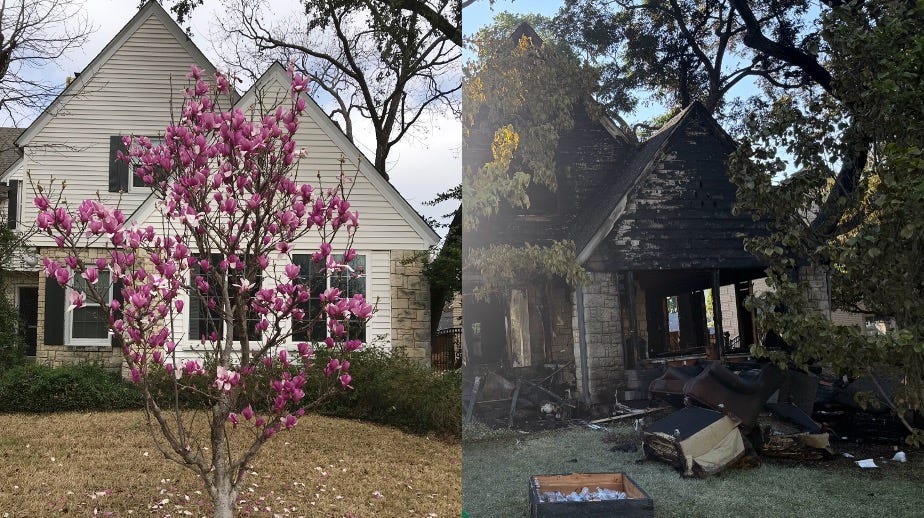
“Our house is on fire.”
That was the last thing my wife said to me as I boarded a plane home from work in Florida. “Let me get on the plane,” I told her. “We can reconnect as soon as I get a signal.” A few minutes later my daughter, Barrett, called me from the scene. My wife had called to tell her the alarm had triggered, and she had driven over to check on it. “It’s bad,” she told me. “I’ll pick you up at the airport when you land.”
I boarded and pulled out my laptop to do what I do without thought or concern literally thousands of times on hundreds of flights a year. But this time on this flight — nothing. “Ladies and gentlemen,” a cheerful flight attendant announced. “The captain has asked me to inform you that there will be no wifi access on this flight, but you can still enjoy all the free entertainment available on our onboard system. So enjoy that and as soon as we’re in the air, we’ll look forward to serving you. Have a great flight!”
My house was on fire, and I was completely shut off from anyone who could tell me anything more than that. I had no idea what was really happening or what to expect when I got home. Just a deeply felt sense that forces were at work beyond my control, and that my life was changing in some deep and irreversible way.
I know it was not unlike what many of the people in our business are feeling in one way or another. It’s like the trades keep screaming, “The house is on fire!” but no one can tell you definitively what that means. You just have the undeniable feeling that something is being irretrievably consumed and lost and there is nothing you can do to stop or to change it. The house is burning and no one can say what, if anything, will be left standing or salvageable when it’s done. All anyone really knows is that, whatever is left and however it may be rebuilt, it won’t be the house it was before. You may still have a job, but it won’t be the job you had before. You may still be in the business, but it won’t be the business it was before.
The trades keep screaming, “The house is on fire!”
The only choice left to you — the only thing in your control — is how you deal with that.
In the case of my house, that meant dealing with the loss of a space that held the life of my family for over forty years.
We moved in when my daughters were five and one. They are now forty-three and thirty-nine. For much of their childhood, my grandmother, their great-grandmother, was still alive and a frequent visitor. Both of their grandmothers were still with us. And all were here for all those things that mark the life of a family: Halloweens, Thanksgivings, Christmases, birthdays and recitals, and first days of school. The house was full of things that memorialized those times and times like them from generations before: furniture, wedding dresses, children’s art, family photos, yearbooks, and letters.
The time had come to let it all go.
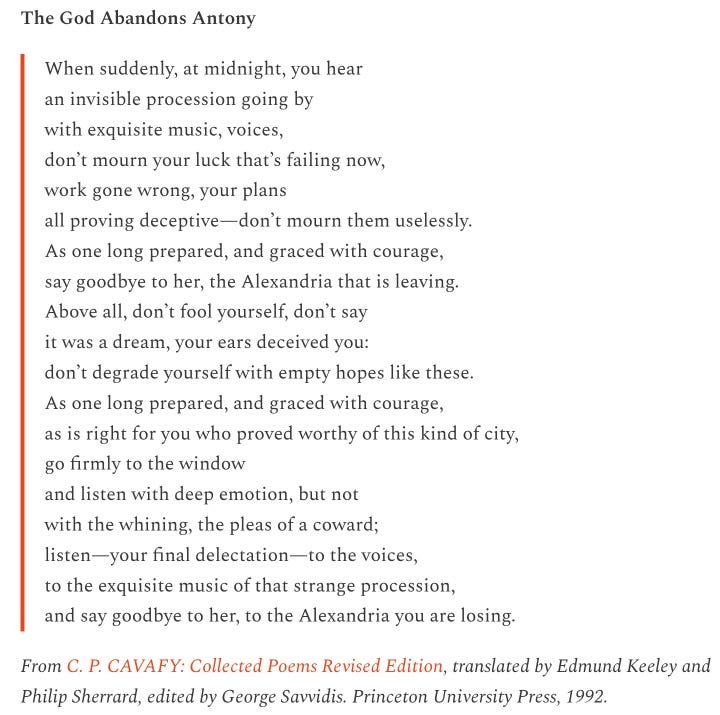
I found myself thinking of C.P. Cavafy’s poem, The God Abandons Antony. The poet instructs Marc Antony on saying goodbye to his beloved city of Alexandria, which is on the verge of being lost to the advancing Octavian. In his Life of Antony, Plutarch had described the night before the final assault, saying the Alexandrians heard invisible revelry moving through the city — a Dionysian procession that passed toward the gates facing the enemy and then vanished.
Over the last few years, I’ve been in more than one television station that felt like an essential life force was leaving the building. Whole floors quiet and abandoned. Amazing, heroic, impossible people had lived and worked and laughed and played there, but the gods, it seemed, were moving on.
In fact, in the television news world, moving on has become an inescapable theme.
On a near daily basis, you can find someone posting on social about finding a job out of TV news, thankful that they got out before someone forced them out. They want you to know that you too can find a life you can love outside of television. Often, they include an invitation to “call me if you want to talk.”
Then, of course, there are those still in the business who are focused on what they believe it will take to secure some kind of future — the “here’s what we’ve done wrong and here’s what it will take now to get it right” conversation.
These conversations are important and essential, and it’s good they are front and center. In Man’s Search for Meaning, holocaust survivor Viktor Frankl observed that chances of survival seemed better for those who could summon an imagination for the future. When life had literally robbed them of control over everything except their ability to project themselves into a different future, they still managed to do that.
But this business with my house has me bothered by the feeling that something is often missing. That talking about what’s ahead of you somehow depends on mastering how you talk about what’s behind you.
While the last thing we should do is live in the past, it may be the first thing we should do is give thanks for it.
Not in a sentimental “those were the good old days” way. Not in a whiny “poor me” way. Not in a “please make this go away” way. And not unemotionally, but with the “deep emotion” and courage of someone who knows what they had — and was worthy of having it.
One evening a few days after the fire, I sat with my wife and two grown daughters on the patio behind our dark and silent house. We knew it was the last time we would be together before they took it all apart, and we’d come to thank the house for all the ways it had sheltered and blessed our lives together.
It felt essential, before we made way for what’s to come, to fully acknowledge what had been.
Something rich and special happened here. Something worthy of our grief. And of our gratitude.
I needed to remember and cry and hold the hands of those I love most and say a last goodbye. Not with “the whining, the pleas of a coward,” but, to paraphrase Cavafy, as one worthy of the life we had made there.
And we needed to give thanks for each other. To remember that the real heart and soul of things was not the house itself, but how we had lived together as a family inside the house.
Once we’d done that, I was ready to move on.
One of the most comforting and meaningful things to me over the last several weeks has been the friends in my professional community who have reached out — just to let me know they cared and were thinking about me. It’s been a poignant reminder that the heart and soul of my television news community is not the work itself. It’s the people with whom I get to do the work.
If this all seems dramatic, you’ll have to cut me a little slack. Personally, it’s been a dramatic few weeks and I’m a little raw.
I just wanted to be sure and say that, if you’re facing the loss of something precious to you, your grief and gratitude — the goodbye conversation — matter as much as those other conversations about what happens next.
Whether you’re saying goodbye to a career or a job or a house, whether you’re finding your way in the business or making your way out of it, you may find that moving on begins by giving the deepest kind of thanks for where you’ve been and how it’s blessed you.
And, especially, for the people you’ve met along the way.
Barry, I am so sorry that the Nash family had to endure this. Praying for wisdom, healing and wholeness!
Well told, Barry. Here’s to moving on with gratitude.